

Optical Testing
Browse our optical test equipmentSplicing & Testing Frequently Asked Questions
+ What are the primary differences between the FiberFox Mini 4S+, 5C+, and 12R+?
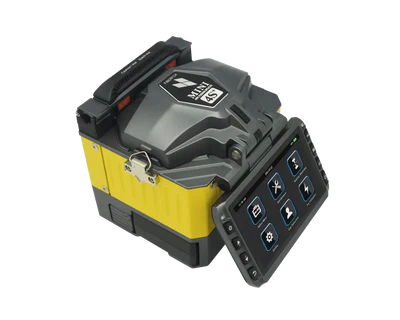
The Mini 4S+ is an active V-groove alignment splicer ideal for FTTH and general maintenance. The Mini 5C+ is a premium 6-motor core-alignment splicer designed for ultra-low loss splices on long-haul and backbone networks. The Mini 12R+ is a dedicated mass fusion splicer capable of splicing up to 12-fibre ribbons simultaneously, making it the standard for high-density data centre and SmartRIBBON™ deployments.
+ What is the AOCAT technology used in the FiberFox Mini 5C+?
AOCAT (Automatic Optical Core Analysis & Tracking) is a sophisticated 6-motor alignment system. Unlike standard splicers that align the outer cladding, AOCAT uses advanced cameras and high-speed processing to identify, analyse, and track the actual centre of the glass core in real-time before the arc is discharged.
+ How does AOCAT technology improve splice quality?
AOCAT technology significantly improves splice quality by compensating for fibre imperfections such as core eccentricity or non-circularity. By aligning the actual cores rather than the cladding, it consistently delivers ultra-low splice loss, often achieving 0.01dB for single-mode fibre, which is superior to active V-groove or cladding-alignment models.
+ Can the FiberFox Mini 12R+ splice both single fibres and ribbon fibres?
Yes. While the Mini 12R+ is optimised for ribbon fibre (up to 12 fibres), it can splice single fibres by using the appropriate interchangeable fibre holders. This makes it a versatile tool for technicians who primarily work on high-core-count backbones but occasionally need to perform single-circuit repairs.
+ Is the Mini 4S+ suitable for outdoor FTTX installations?
Absolutely. The Mini 4S+ is designed for portability and durability in the field. It features a ruggedised chassis that is shock, water, and dust resistant, paired with a bright touchscreen that remains visible in direct sunlight, making it the ‘workhorse’ for last-mile FTTX deployments.
+ What is the typical battery life for the FiberFox Mini series splicers?
The Mini series is known for its high-capacity dual battery system. The Mini 5C+ comes with two batteries, each supporting 350 cycles (splice and heat) per battery charge. This ensures a full day of field operation without needing a localised power source.
+ Does the Mini 12R+ support SmartRIBBON™ and other high-density ribbon types?
Yes. The Mini 12R+ is fully compatible with modern ribbon technologies, including SmartRIBBON™ and collapsible ribbon types. Its heating system and splice programs are specifically tuned to handle the different thermal requirements of mass fusion splicing for various ribbon manufacturers.
+ How easy is it to maintain the electrodes on FiberFox Mini splicers?
FiberFox units are designed for easy field maintenance. Electrodes are rated for up to 5,500 splices (depending on model) and can be replaced in minutes without specialised tools. The onboard software also includes an automated ‘arc calibration’ feature to ensure consistent performance as electrodes wear.
+ What is included in the standard FiberFox Mini series kits?
A standard kit typically includes the fusion splicer, a high-precision cleaver, dual batteries, a cooling tray, spare electrodes, and a ruggedised carrying case. This ‘ready-to-splice’ package ensures technicians have everything needed for immediate deployment.